
All

Floorstanding loudspeakers — German Physiks HRS-130
Description, images, technical data and specifications
German Physiks HRS-130
Image source - (c) German Physiks
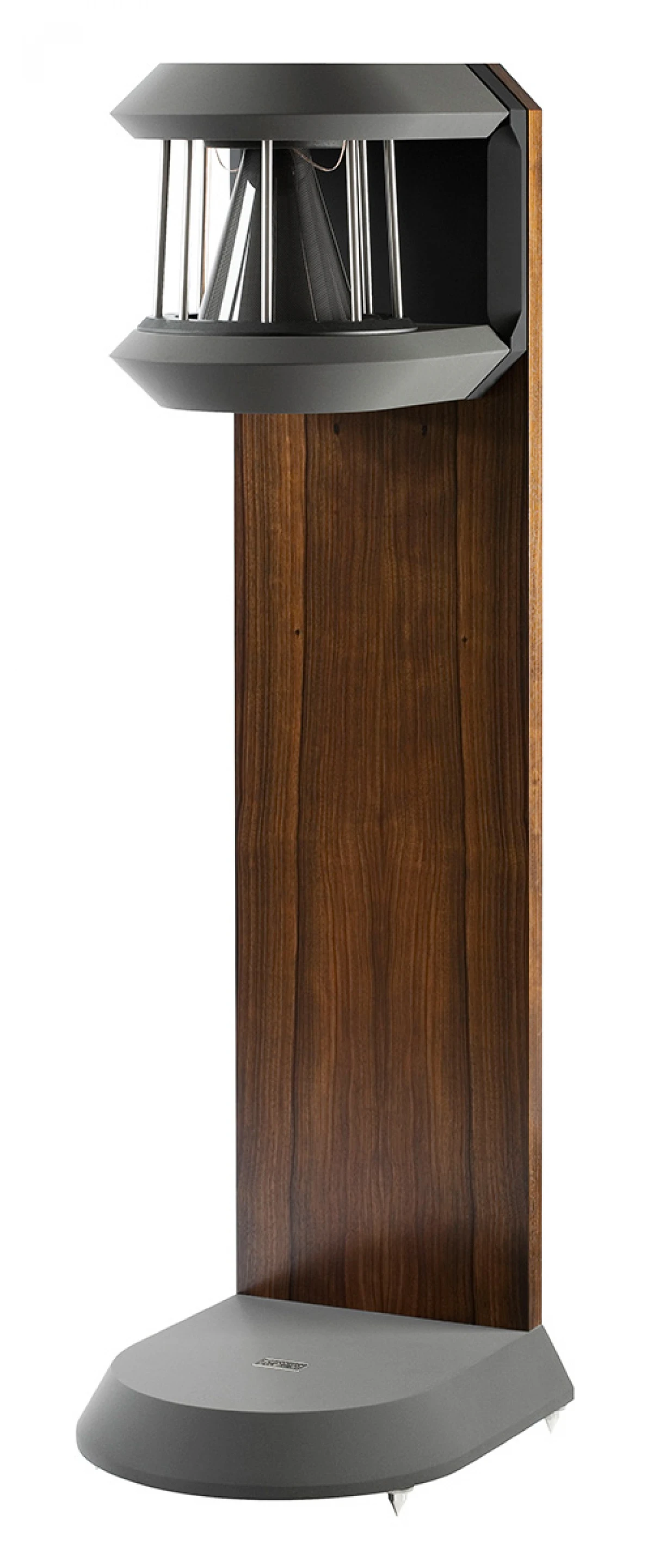
The HRS-130 is the entry-level floorstander from German Physiks, the brand of DDD Manufactur GmbH, founded in 1992 and based in Frankfurt. It replaced the long-running HRS-120 and, like every German Physiks model up to the Gaudi Mk III, it uses the company's own omnidirectional DDD driver, mounted on top of a slim octagonal body with a downward-firing woofer in the base.
Key specs that matter
One carbon-fibre DDD driver covers 220 Hz to 24 kHz, and a 10-inch woofer firing downward handles the bass. It is the same bass unit used in the far more expensive PQS-402. Frequency response is 29 Hz to 24 kHz, sensitivity is 86.9 dB and impedance is 4 ohms. Dual WBT nextgen terminal pairs allow separate feeds to the DDD and woofer sections. The speaker stands about 1.26 m tall. Standard finishes are high-polish black or white polyester, with satin or high-polish veneer, paint and carbon-fibre to special order. At launch it cost GBP 11,900 to 15,450 depending on finish.
Engineering and use context
The DDD driver is a carbon-fibre cone only 0.15 mm thick with a total moving mass of about 3.5 g, and each one is hand-built in the German Physiks factory. It is a wide-band transducer that combines pistonic, bending-wave and modal radiation, and its geometry spreads sound evenly around the speaker instead of beaming it forward. As one driver covers everything above the woofer, there is no crossover in the midrange, and the driver is phase-linear across its working range. It runs in free air with no enclosure behind it. The woofer sits in a sealed box linked through a small opening to a smaller cavity at the top of the cabinet. This cavity is a Helmholtz resonator tuned to the resonant frequency of the main bass enclosure to smooth the bass response. The cabinet is slightly taller than that of the HRS-120, which made room for a larger resonator and the step from an 8-inch to a 10-inch woofer. The crossover was developed from the one in the larger Borderland Mk IV, and the woofer fires down and out through openings around the plinth.
Pairing
The HRS-130 is not an easy load, and German Physiks recommends an amplifier with at least 70 W into 4 ohms.
Alternatives
The Borderland Mk IV uses the same DDD driver with a larger bass system in a bigger cabinet.
Specifications
Model name
HRS-130
Frequency Response low +/- 3dB (Hz)
29
Frequency Response high +/- 3dB (Hz)
24 000
Sensitivity (dB at 1 W/1m)
86.9
Impedance (Ohms)
4
Power amplifier requirements (W)
4 - 70
Has internal amplification
N/A
Internal amplification power (W)
N/A
Size (sm)
32.5 x 116.0 x 32.5
Weight (kg)
37.4
Official link
More components
Floorstanding loudspeakers
German Physiks Emperor MK II
Floorstanding loudspeakers
German Physiks Loreley MK III
Floorstanding loudspeakers
German Physiks PQS-402
Floorstanding loudspeakers
German Physiks PQS-302
Floorstanding loudspeakers
German Physiks PQS-100